
Foundations
Stock Market
The network in which shares are issued, routed, quoted, and traded—not one building or one exchange.
Definition
The stock market is the broader system for issuing and trading stocks through exchanges, over-the-counter markets, and electronic venues.
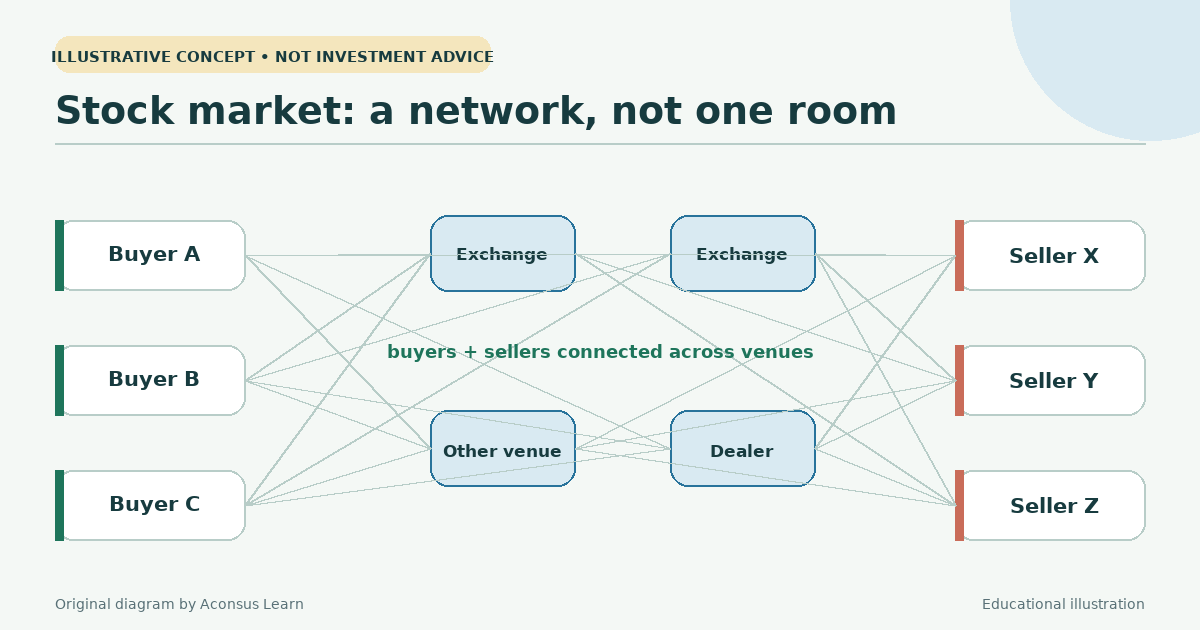
A market made of markets
The phrase covers more than the New York Stock Exchange or Nasdaq. An investor’s order may execute on a registered stock exchange, an alternative trading system, or through another regulated venue. Brokers route orders, and the execution venue is where buyer and seller are matched.
The primary market is where newly issued shares raise capital for an issuer. The secondary market is where existing shares change hands among investors. Most prices seen in brokerage apps concern secondary trading; buying there usually sends money to the seller, not directly to the company.
Prices, liquidity, and information
Competing orders help discover a price, but execution is not frictionless. A bid is what a buyer offers; an ask is what a seller requests. Their difference is the bid-ask spread. Fast markets, low trading volume, or limited public interest can widen spreads and make the last traded price a poor guide to the next execution.
Markets aggregate expectations rather than reveal certainty. Company disclosures, economic data, rates, and investor sentiment can change demand quickly. A market index summarizes a selected basket, but no single index represents every listed and unlisted stock.
Market structure is jurisdiction-specific
U.S. national securities exchanges register with the SEC and are self-regulatory organizations. Alternative trading systems operate under a different framework. Other countries use their own regulators, venue categories, settlement rules, and investor protections.
Market rules can promote fair dealing and disclosure but cannot remove investment loss. Trading can also pause during severe conditions, and an order’s type affects its price certainty and execution certainty.
Hypothetical example
Lee submits an order through a broker to buy 100 listed shares. The broker routes it to an execution venue, which may or may not be the exchange where the company is listed. The trade is a secondary-market transaction between investors. A market order prioritizes execution, so Lee’s actual price can differ from the quote visible seconds earlier.
Limitations to keep in mind
- Market-wide repricing can reduce many stocks at once.
- Liquidity can deteriorate, increasing spreads and slippage.
- Order routing, halts, operational failures, and settlement rules can affect trading without changing the issuer’s business.
Sources and further reading
- Market Participants — U.S. Securities and Exchange Commission — Investor.gov
- Where Do Stocks Trade? — FINRA
Published ; Reviewed . Automated editorial source comparison; no external certification Claims compared with cited sources: 1
Investor.gov’s participant page supports the venue categories but does not itself provide FINRA’s detailed routing description; the claim and finding keep that evidence boundary explicit.