
Foundations
Stock Exchange
What an exchange does, how listing differs from trade execution, and why an exchange is only one part of the market.
Definition
A stock exchange is an organized, regulated marketplace that brings together multiple buyers and sellers of securities under defined membership and trading rules.
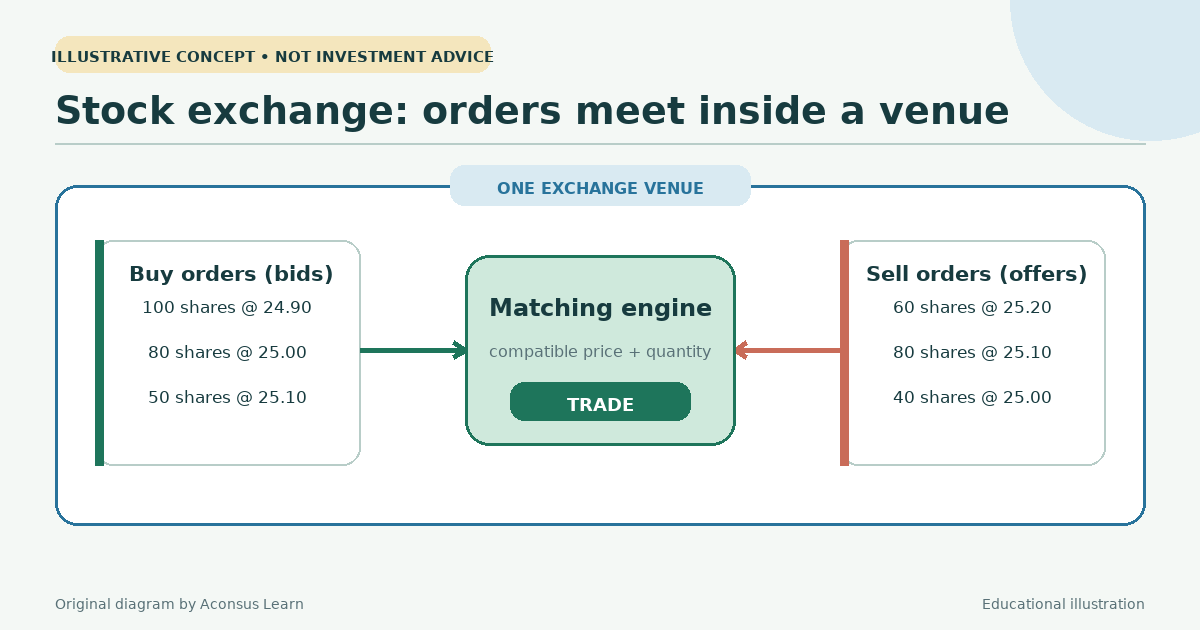
Listing and trading
An exchange can set standards for companies that list securities and operate systems through which orders interact. “Listed on” identifies the issuer’s listing venue; it does not mean every trade in that stock executes there. Brokers may route an order to another exchange or eligible off-exchange venue.
Exchanges publish quotations and report executed transactions through market-data systems. They also establish member conduct and operational rules. In the United States, national securities exchanges register with the SEC and function as self-regulatory organizations subject to SEC oversight.
Exchange versus stock market
A stock market is the overall trading ecosystem; an exchange is a particular type of venue inside it. Alternative trading systems also bring together buyers and sellers but are not exchanges or self-regulatory organizations under the same U.S. structure. Wholesalers and single-dealer platforms add further routing possibilities.
This distinction matters when assessing execution. The logo beside a listed company does not tell an investor where a particular order traded, what spread was available, or whether the displayed quote remained available.
Rules do not eliminate trade-offs
A market order generally seeks prompt execution but does not guarantee price. A limit order controls the worst acceptable price but might not execute. Venue rules, order priority, available liquidity, and rapid price changes all shape the result.
The definition here follows U.S. sources. Legal definitions and exchange oversight differ abroad, and digital-asset platforms that call themselves exchanges may not have the same registration, investor protections, or market structure as a national securities exchange.
Hypothetical example
A company lists its shares on Exchange A. An investor enters a buy order through a broker, but the best available terms lead the broker to execute it on Exchange B. The listing and execution venues differ, yet the investor receives the same class of the company’s shares. The fill price still depends on the chosen order and available liquidity.
Limitations to keep in mind
- An exchange listing is not an endorsement of investment quality or a guarantee against loss.
- Prices can move before an order executes, and limit orders may remain unfilled.
- Similarly named venues in other asset classes or countries may operate under materially different protections.
Sources and further reading
- Where Do Stocks Trade? — FINRA
- Market Participants — U.S. Securities and Exchange Commission — Investor.gov
Published ; Reviewed . Automated editorial source comparison; no external certification Claims compared with cited sources: 1
Every trade in a listed security need not occur on its listing exchange; this commonly misunderstood distinction was made explicit.