
Investment types
Stock
What a share of stock represents, how shareholders may earn returns, and why ownership can still lose all its value.
Definition
A stock is an equity security representing a fractional ownership interest in an issuing company. A share is one unit of that stock.
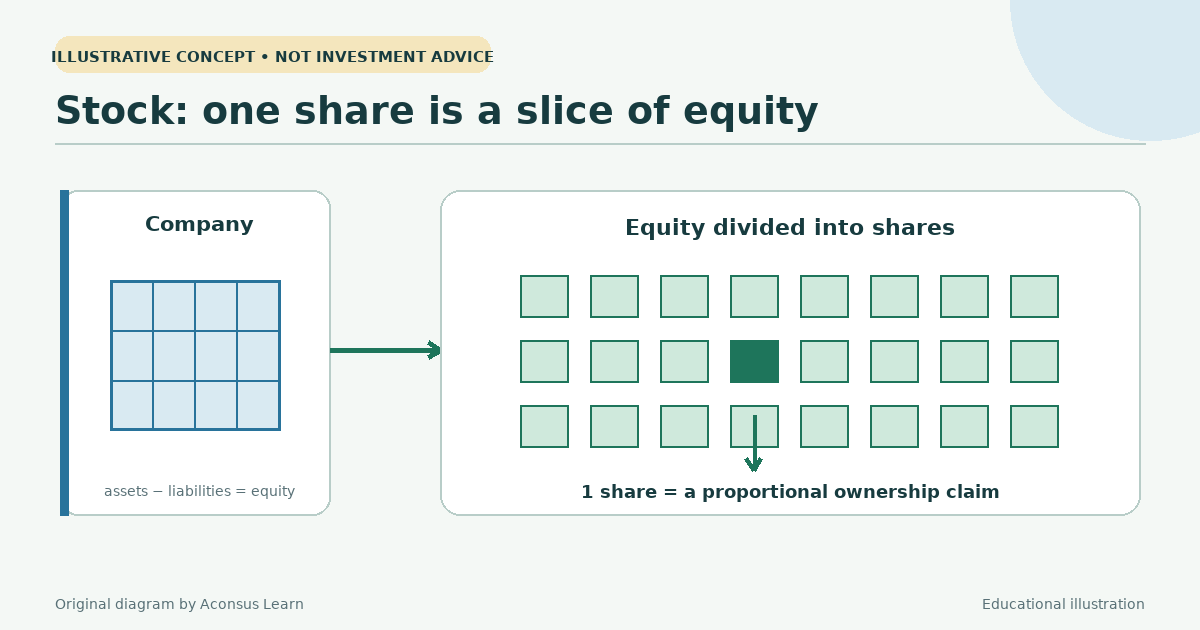
Ownership, not a guaranteed payout
Buying common stock makes the shareholder a residual owner. The company uses capital in its business; the investor participates in success or failure through changes in the share price and, if declared, dividends. A dividend is discretionary for common stock and can be reduced or stopped.
Ownership rights vary by share class and jurisdiction. Common shares often carry voting rights, while preferred shares commonly have different dividend and liquidation terms. The prospectus, corporate filings, and governing documents—not the word “stock” alone—define those rights.
Why the price moves
In the secondary stock market, buyers and sellers continually reassess expected profits, interest rates, competition, and risk. The quoted price is the price at which market participants can transact under current conditions, not an official statement of the company’s intrinsic value.
A shareholder’s total return combines price change and cash distributions, adjusted for costs and taxes. A profitable company can still be a poor investment if expectations embedded in the purchase price were too optimistic. Conversely, a price decline does not by itself prove that the business has failed.
Place in the capital structure
Stockholders rank behind creditors if a company is liquidated. Bondholders and other creditors have contractual claims; common shareholders receive only what remains after higher-priority claims, potentially nothing. This residual position helps explain both stocks’ upside and their possibility of total loss.
Public stocks may be easy to trade, but liquidity differs by company and market conditions. Diversified stock funds can reduce exposure to one issuer, yet remain exposed to broad equity-market declines.
Hypothetical example
An investor buys 20 shares at $50, committing $1,000 before fees. One year later the shares are worth $54 and the company has paid $1 per share in dividends. The pre-tax, pre-cost total is $1,100: $1,080 market value plus $20 cash, a 10% return. If the price had fallen to $35, the dividend would not prevent a substantial loss.
Limitations to keep in mind
- The issuer can perform poorly or fail, and common stock can become worthless.
- Prices can be volatile, especially over a short horizon or for thinly traded shares.
- Concentrating in one company, industry, or country increases exposure to a narrow event.
Sources and further reading
Published ; Reviewed . Automated editorial source comparison; no external certification Claims compared with cited sources: 1
Share-class rights and creditor priority vary in detail, so the article describes typical common stock and directs readers to issuer documents.