
Foundations
Market Index
How an index turns a selected basket and weighting method into a benchmark, and what its headline return leaves out.
Definition
A market index is a rules-based measure that tracks the performance of a selected basket of securities representing a market, segment, or strategy.
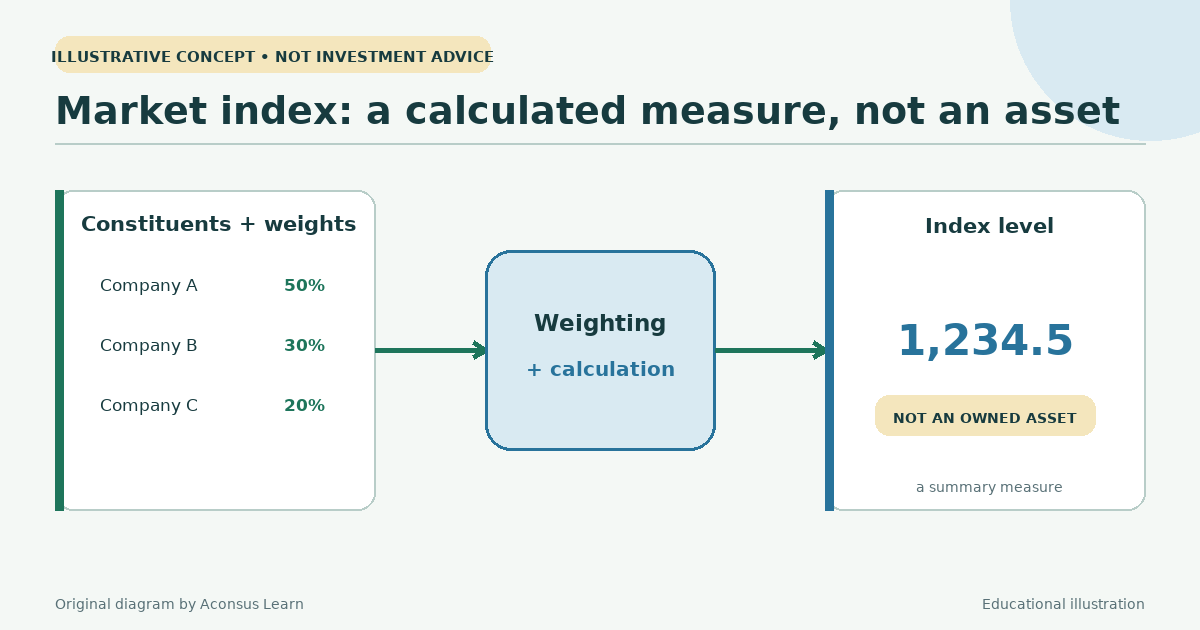
Selection and weighting
An index provider defines eligible securities, selection rules, weights, rebalancing, and calculation. Market-capitalization weighting gives larger companies more influence; equal weighting and price weighting produce different exposures. Two indexes labeled “U.S. stocks” can therefore report different returns.
An index value is a calculated measure, not a portfolio an investor can purchase directly. An index fund attempts to implement it and introduces fees, taxes, trading, and tracking differences.
Benchmark and market shorthand
Indexes summarize markets and provide benchmarks for evaluating investments. The comparison should be like-for-like: a U.S. large-company fund may reasonably be compared with the S&P 500, while that index is a poor benchmark for a short-term bond fund or global small companies.
A benchmark return needs a return convention. A price-return index excludes reinvested cash dividends; a total-return index includes them under its methodology. Currency and tax assumptions can also alter the reported result.
What the headline cannot say
An index reflects its constituents, weights, and calculation—not every investor’s experience. Constituents change over time, and historical data before an index launch may be back-tested rather than live. Strong index performance can also be driven by a few heavily weighted securities. Survivorship and methodology changes deserve attention when interpreting a long chart.
Index inclusion is not a recommendation, and past index returns do not predict future returns. Read the provider’s methodology and distinguish a broad market measure from a narrow thematic or factor index. Also check the calculation calendar: different closing times and holidays can make two otherwise sensible benchmarks diverge over a short comparison period.
Hypothetical example
Imagine an index with Company A worth $800 million and Company B worth $200 million. In a simple capitalization-weighted version, A has 80% weight and B 20%. If A rises 5% while B falls 5%, the index rises about 3% before calculation adjustments. An equal-weighted version would be roughly flat: methodology changes the headline.
Limitations to keep in mind
- A label may conceal concentration, sector tilts, or limited geographic coverage.
- The wrong benchmark can make performance comparison misleading.
- Back-tested history, constituent changes, and price-versus-total-return choices can be misunderstood.
Sources and further reading
- Market Indices — U.S. Securities and Exchange Commission — Investor.gov
- Get Off the Bench: A Look at Benchmarks — FINRA
Published ; Reviewed . Automated editorial source comparison; no external certification Claims compared with cited sources: 1
Some sources colloquially describe an index as tracking a market, while actual coverage depends on selection and weighting; the article makes that limitation explicit.