
Investment types
Index Fund
How a fund seeks to track a chosen index, why tracking is never exact, and which costs and methodology choices matter.
Definition
An index fund is a fund—commonly a mutual fund or ETF—that uses a passive strategy designed to approximate the return of a specified market index before fees.
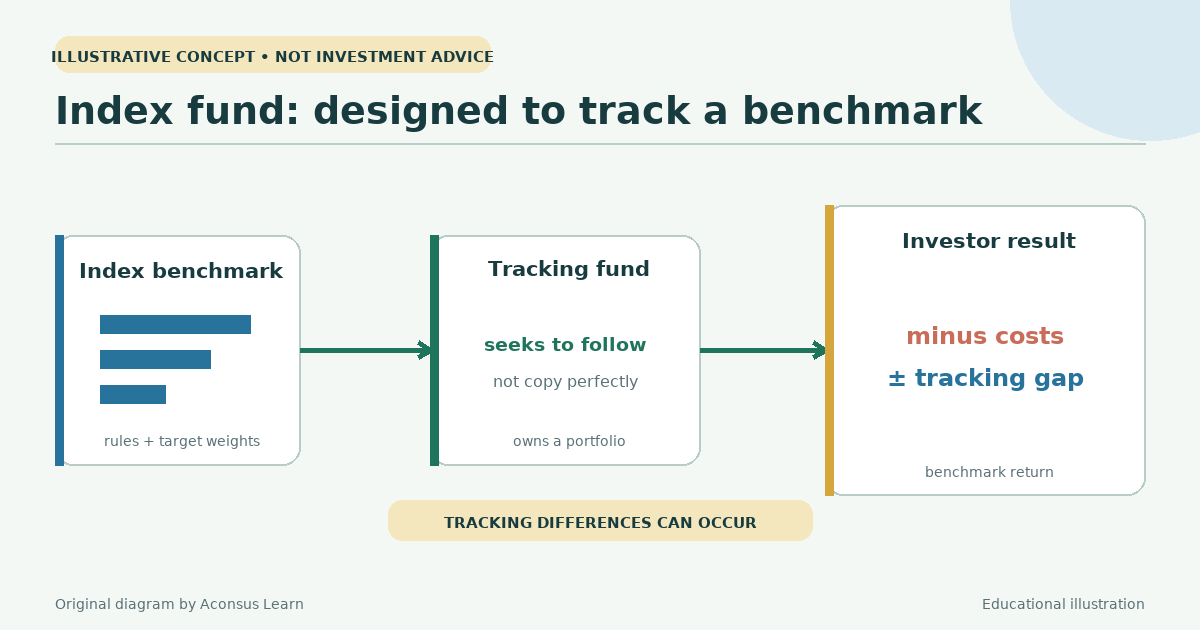
Following a rule set
The chosen market index determines the target universe, weighting, and rebalancing rules. A fund may hold every constituent in index weights or sample a representative subset. It may also use derivatives or cash for implementation. Investors own the fund, not the abstract index itself.
Passive does not mean no decisions or no change. The index provider sets methodology and updates constituents, while the fund manager trades to reflect those changes, handles cash flows, and manages taxes and corporate actions.
Why fund and index returns differ
Expense ratios, transaction costs, withholding taxes, cash holdings, sampling, and trading timing create tracking difference. Tracking error describes variability in that difference. A low advertised fee is useful but does not alone establish accurate tracking or low total ownership cost.
The legal wrapper also matters. An ETF trades intraday with spreads and possible premiums or discounts; a mutual fund transacts at NAV and may have different purchase minimums, loads, or tax mechanics.
Indexing does not remove risk
A broad index fund may diversify issuer-specific exposure, but it fully participates in the market segment it tracks. A technology, commodity, or single-country index can be concentrated despite holding many securities. Weighting by market capitalization can also give the largest constituents substantial influence.
Before investing, identify the exact index, methodology, reconstitution schedule, fund costs, securities-lending policy, and domicile. “S&P 500 index fund,” for example, describes an objective, not one interchangeable product. Check whether distributions are paid or reinvested and whether the quoted performance is before or after fund expenses. Those details affect the return an investor can actually receive.
Hypothetical example
An index returns 8.0% during a year. A fund tracking it charges 0.20%, incurs 0.05% of net implementation drag, and finishes at 7.75% before the investor’s taxes. The 0.25-percentage-point gap is tracking difference. Another fund with the same benchmark may differ because of fees, sampling, cash flows, and trading.
Limitations to keep in mind
- The tracked market can fall, and broad diversification cannot guarantee a profit.
- A narrow or unusually weighted index can create hidden concentration.
- Fees, implementation, taxes, and fund structure can produce persistent tracking difference.
Sources and further reading
- Index Fund — U.S. Securities and Exchange Commission — Investor.gov
- A Look at Non-Traditional Indexes and Funds That Track Them — FINRA
Published ; Reviewed . Automated editorial source comparison; no external certification Claims compared with cited sources: 2
Investor.gov says passive management usually brings lower costs; this was not converted into a universal claim because specialized index products can be expensive.