
Investment types
ETF
How exchange-traded funds combine a pooled portfolio with intraday share trading, plus the costs and structural risks to inspect.
Definition
An exchange-traded fund, or ETF, is a pooled investment fund whose shares trade on a securities exchange at market prices during the trading day.
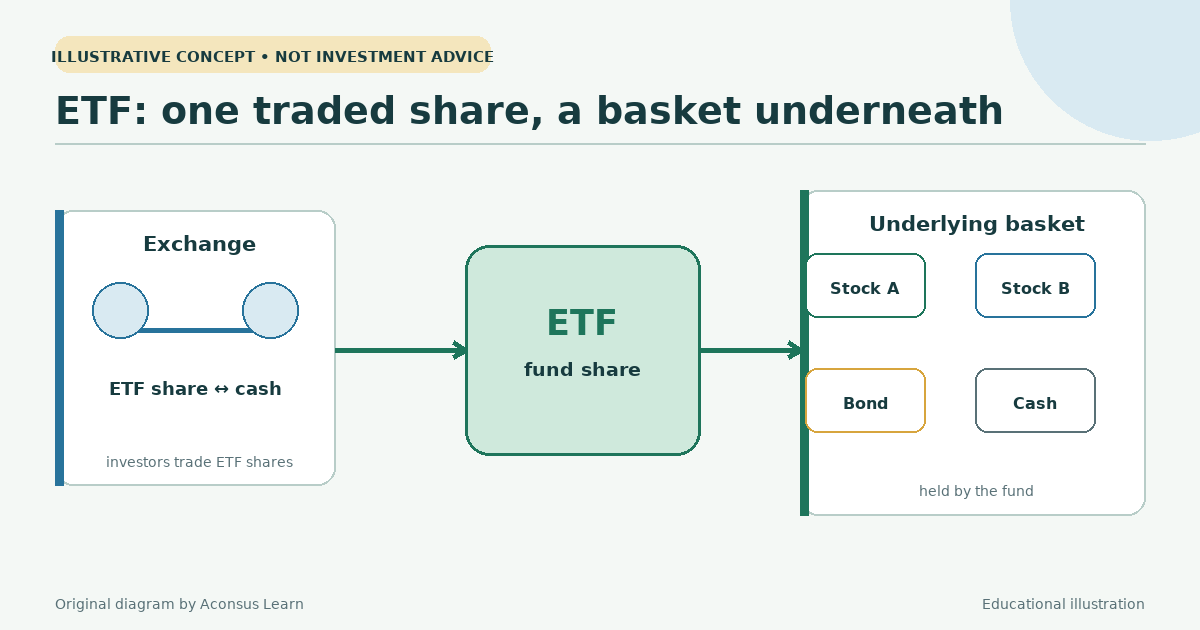
A fund in a tradable share
An ETF can hold stocks, bonds, or other assets according to a stated objective. Owning an ETF share means owning an interest in the fund, not directly owning each underlying security. Some ETFs follow an index, while others are actively managed; “ETF” describes a structure, not one strategy or risk level.
Large institutional participants can create or redeem blocks of ETF shares using the fund’s specified basket or cash. This mechanism helps connect the trading price with the value of holdings, but it does not guarantee that the two are always equal.
Market price and net asset value
ETF shares trade throughout the day, so their market price changes with orders. The fund also calculates net asset value, usually daily. A share may trade at a premium above NAV or a discount below it, especially when underlying markets are closed, hard to price, or stressed.
Trading brings a bid-ask spread and possibly brokerage charges in addition to the fund’s expense ratio. A low expense ratio does not by itself make a lightly traded or narrowly focused ETF inexpensive to enter and exit.
ETF does not mean index fund
An index fund may use the ETF structure, but ETFs can be active, leveraged, inverse, concentrated, or single-stock products. Likewise, a mutual fund may track an index. Investors should inspect the objective, holdings, index methodology, leverage, tax treatment, and prospectus rather than infer safety from the label.
U.S. regulatory and tax details do not transfer automatically to UCITS ETFs or products domiciled elsewhere. Currency exposure, withholding taxes, and investor protections can differ.
Hypothetical example
An ETF reports NAV of $25.00 per share, while available exchange quotes are $24.97 bid and $25.03 ask. A buyer crossing the ask pays a small premium to NAV and bears the spread immediately. If the ETF holds overseas shares whose home market is closed, the difference may reflect traders’ current estimates rather than a malfunction.
Limitations to keep in mind
- Underlying assets can decline; diversification is not guaranteed by the ETF label.
- Premiums, discounts, spreads, and low liquidity can worsen the investor’s realized price.
- Leveraged, inverse, derivative-based, and concentrated ETFs can behave very differently from broad unleveraged funds.
Sources and further reading
- Characteristics of Mutual Funds and Exchange-Traded Funds (ETFs) — U.S. Securities and Exchange Commission — Investor.gov
- Authorized Participants — U.S. Securities and Exchange Commission — Investor.gov
- Exchange-Traded Funds and Products — FINRA
Published ; Reviewed . Automated editorial source comparison; no external certification Claims compared with cited sources: 2
FINRA discusses the wider ETP category, which also includes non-fund products such as ETNs; the article does not apply ETF ownership language to ETNs.