
Investment types
Mutual Fund
How an open-end mutual fund pools investor money, prices shares at NAV, distributes returns, and charges costs.
Definition
A mutual fund is an open-end investment company that pools money from investors in a managed portfolio; each share represents a proportional interest in that portfolio.
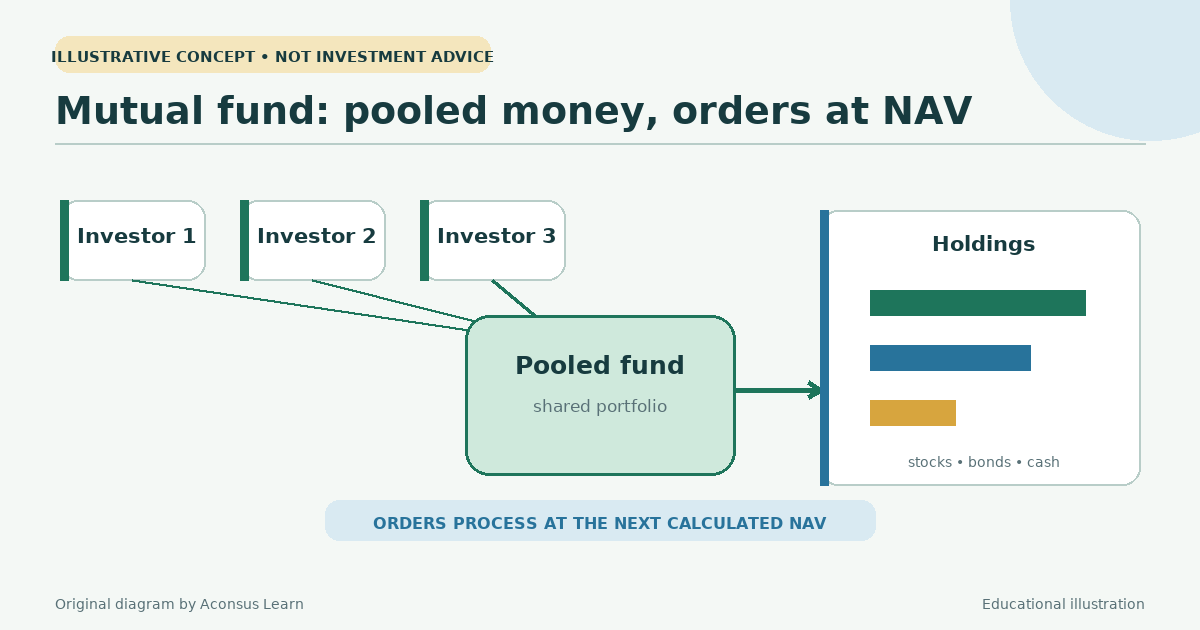
Pooling and management
A fund follows the objective and policies in its prospectus. It may own stocks, bonds, money-market instruments, or other assets. Professional management and broad holdings can be convenient, but a fund is diversified only to the extent its actual portfolio is diversified.
Returns flow from the holdings after expenses. Interest and dividends may be distributed as income; realized gains may create capital-gain distributions; and changing portfolio values change net asset value. Reinvesting a distribution buys more shares but does not make the distribution free or necessarily avoid tax.
Read beyond past performance
Mutual funds can be actively managed or can operate as index funds. The structure does not reveal strategy, quality, or cost. Compare objective, benchmark, holdings, turnover, expense ratio, loads, risk disclosures, and manager approach.
U.S. mutual funds described by the sources are SEC-registered products and are not bank deposits insured against market loss. Other jurisdictions use different fund forms and rules; similarly named products may price or distribute differently.
Hypothetical example
A mutual fund has $102 million of assets, $2 million of liabilities, and 5 million shares. Its NAV is ($102m − $2m) ÷ 5m = $20. An investor’s order receives the next calculated NAV, not necessarily $20. If a 3% sales load applies, the economic cost must be included when comparing alternatives.
Limitations to keep in mind
- Holdings can decline, and registration or professional management does not insure principal.
- Expense ratios, loads, turnover costs, and taxes reduce investor returns.
- Concentrated strategies and redemption pressure can create market or liquidity risk.
Sources and further reading
- Mutual Funds — U.S. Securities and Exchange Commission — Investor.gov
- Mutual Funds — FINRA
Published ; Reviewed . Automated editorial source comparison; no external certification Claims compared with cited sources: 1
The broad term “fund” can include closed-end funds and other structures; this article specifically defines the conventional U.S. open-end mutual fund.