
Investment types
Bond
How lending to an issuer creates contractual payments, and how rates, credit quality, maturity, and liquidity affect value.
Definition
A bond is a debt security through which an investor lends money to an issuer that promises specified payments, commonly interest and repayment of principal at maturity, subject to the issuer’s ability to pay.
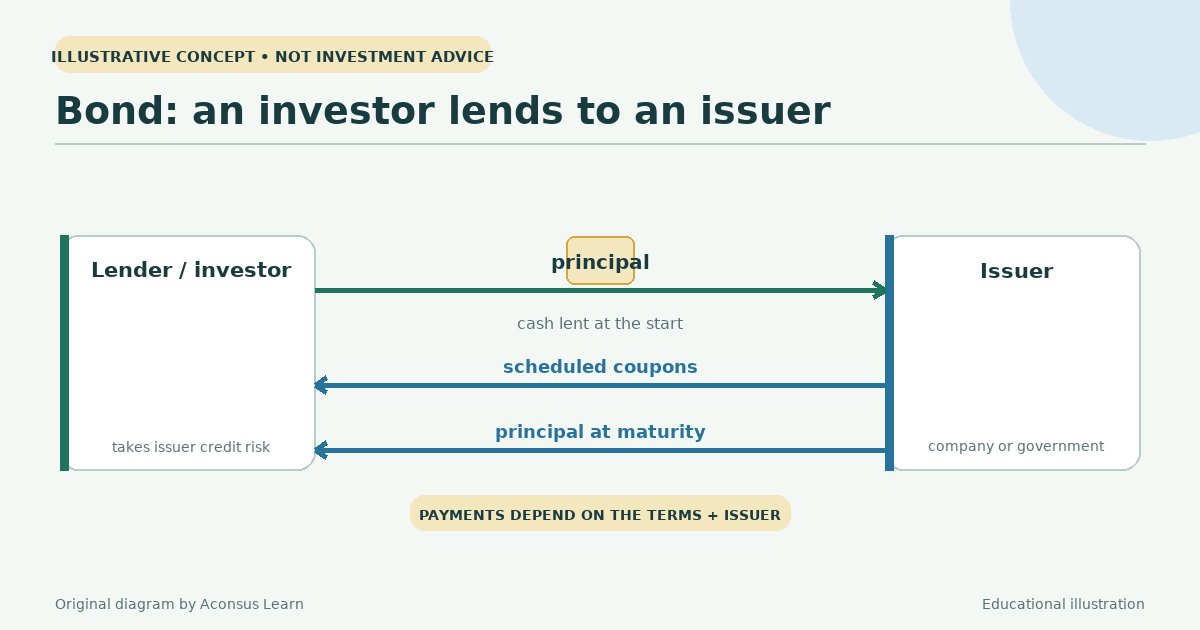
A contractual claim
Governments, municipalities, and companies issue bonds to borrow. The face or principal amount is due under the bond’s terms, while the coupon determines stated interest payments. Some structures differ—zero-coupon bonds, floating rates, callable bonds, and asset-backed securities require more specific analysis.
Unlike a stock, a conventional bond does not confer company ownership. Its contractual claim generally ranks ahead of common equity in insolvency, but priority does not ensure full recovery. Government backing also varies: a municipal, agency, or foreign sovereign bond is not automatically guaranteed by the U.S. government.
Price before maturity
A holder need not keep a bond until maturity, but its market price can be above or below face value. When market yields rise, an existing fixed-rate bond’s price generally falls because newer debt offers more attractive income; when yields fall, its price generally rises. Longer maturities and lower coupons usually create greater rate sensitivity.
Yield summarizes return under stated assumptions, but different yield measures answer different questions. Yield to maturity assumes scheduled payments and reinvestment and does not erase default, call, tax, or trading risk.
Read the specific terms
Credit quality concerns whether the issuer can pay on time. Ratings can inform analysis but are opinions, can change, and are not guarantees. Investors should also examine maturity, seniority, collateral, call provisions, currency, and market liquidity.
Tax treatment differs by issuer, account, investor residence, and jurisdiction. Statements that some municipal interest may receive favorable U.S. tax treatment should never be treated as universal.
Hypothetical example
A five-year bond has $1,000 face value and pays a 4% annual coupon, or $40 a year, assuming annual payments. If comparable new bonds later yield 5%, buyers will generally pay less than $1,000 for the old 4% bond. A holder who sells then can realize a loss; holding to maturity avoids that sale-price decision but not issuer default or inflation risk.
Limitations to keep in mind
- Credit or default risk: the issuer may delay or miss interest or principal.
- Interest-rate and call risk can change price or shorten expected cash flows.
- Inflation, liquidity, currency, and reinvestment risk can reduce real or realized returns.
Sources and further reading
Published ; Reviewed . Automated editorial source comparison; no external certification Claims compared with cited sources: 2
“Fixed income” does not mean a bond’s market value is fixed. Tax and guarantee treatment varies by issuer and jurisdiction.