
Foundations
Investing
How committing money to assets differs from saving or speculating, and why time, risk, costs, and goals matter.
Definition
Investing is committing money to an asset or venture with the expectation of future income, growth in value, or both, while accepting that the outcome is uncertain and some or all of the money may be lost.
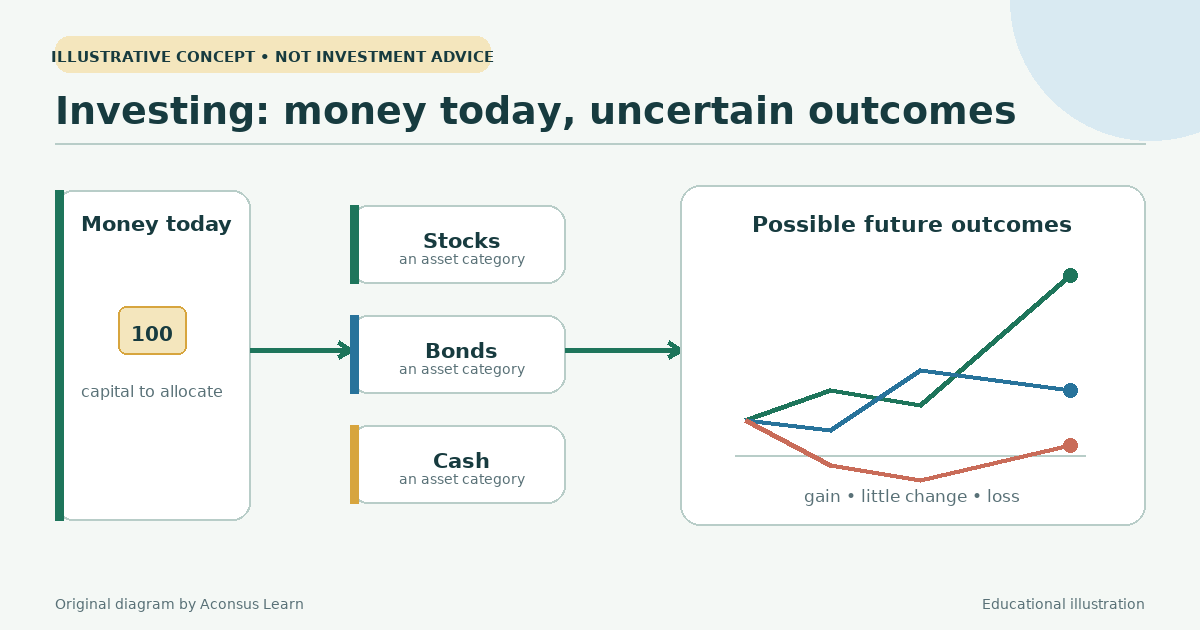
Putting money to work
An investor gives up present spending power to acquire an asset expected to provide a future benefit. Common securities include stocks, which represent company ownership, and bonds, which represent debt. Funds can bundle many securities. Returns may arrive as interest, dividends, distributions, or a higher sale price; none is automatic.
Investing is not the same as holding cash for near-term bills. Cash is usually chosen for accessibility and stability, while market investments fluctuate. Nor does investing make an uncertain result predictable. A sound process starts with the goal, time horizon, capacity for loss, liquidity needs, and the costs and taxes that apply.
From a goal to a portfolio
A portfolio can spread money across asset classes and issuers rather than relying on one outcome. That diversification can reduce company-specific damage, but it cannot prevent a broad market loss. Regular contributions and a long horizon may make short-term swings easier to tolerate; they do not guarantee a profit.
Before buying, read the security or fund disclosures and understand fees. A percentage fee that looks small is deducted repeatedly and reduces the amount left to compound. Rebalancing may restore a planned mix after markets move, while frequent reaction to headlines can turn a long-term plan into market timing.
Rules and taxes depend on location
Investor protections, account types, disclosure rules, and taxation differ by country. The sources below describe the U.S. securities framework; they are educational, not a promise that a product is suitable or protected elsewhere. Deposit insurance generally does not insure the market value of securities.
A practical test is whether the investment can be explained plainly: what is owned, how it could earn money, what it costs, when it can be sold, and how loss could occur. If those answers remain unclear, further research is part of the investment decision.
Hypothetical example
Maya has a ten-year goal and an emergency cash reserve. She contributes monthly to a diversified fund, reviews its prospectus and total fee, and accepts that its value may fall during the decade. The plan is investing because capital is exposed to uncertain market outcomes for a future objective—not because monthly purchases ensure a gain.
Limitations to keep in mind
- Market, credit, inflation, and liquidity risks can reduce purchasing power or principal.
- Fees, taxes, and trading costs reduce the return an investor keeps.
- Fraud, concentration, leverage, and decisions driven by short-term emotion can magnify losses.
Sources and further reading
- Investing Basics — FINRA
- Introduction to Investing — U.S. Securities and Exchange Commission — Investor.gov
Published ; Reviewed . Automated editorial source comparison; no external certification Claims compared with cited sources: 1
Investor.gov is an SEC publication and therefore is treated as one publisher, not as independent confirmation from SEC. The article makes no universal tax or suitability claim.