
Portfolio building
Risk and Return
Return is an investment's gain or loss; risk is uncertainty about outcomes and the possibility of losing money.
Definition
Risk and return describe the trade-off between uncertain investment outcomes and potential reward. Investments offering higher expected return generally require bearing more risk, but greater risk does not promise a greater realized return.
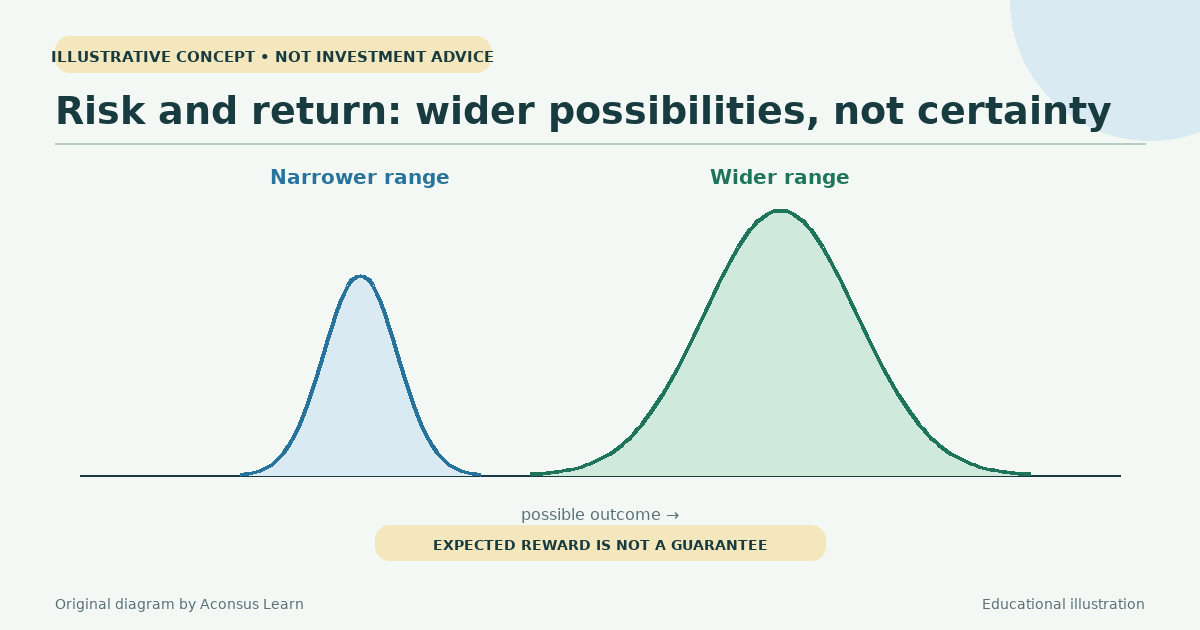
Expected is not guaranteed
FINRA says the risk associated with an investment typically correlates with the return it might achieve. Investor.gov's asset-allocation guide similarly contrasts more volatile stocks and generally less volatile, more modest-return bonds. This is compensation investors may require for uncertainty, not a rule that every risky bet pays.
Return includes income, such as interest or a dividend, plus or minus the change in value. A complete comparison uses the same period and currency, and accounts for fees. Taxes depend on jurisdiction and account, so after-tax outcomes can differ.
Risk has several forms
Price fluctuation is visible, but it is not the only risk. An issuer can default; inflation can erode purchasing power; a security can be hard to sell; exchange rates can move; or an investor can outlive the money. A low-volatility holding may still lose real value after inflation.
Capacity and willingness are distinct. Someone may feel comfortable with losses but lack the financial capacity to wait for recovery. Time horizon, spending needs, debt, emergency reserves, and dependence on the invested sum all belong in the assessment.
Compare like with like
A 10% gain has little meaning without its path and benchmark. Compare total returns over consistent periods and ask how large the declines were, how variable results were, and whether leverage or illiquidity contributed. Volatility measures fluctuation, but it does not capture every danger.
At portfolio level, asset allocation and diversification can shape the trade-off. There is no way to eliminate investment risk while retaining all return potential. Promises of high, steady, guaranteed returns deserve skepticism.
Hypothetical example
Fund A returns 8% and Fund B returns 10% in one year. B is not automatically better: it may have fallen 35% during the year, used leverage, or charged higher fees. An investor needing the money midyear could have experienced a very different result. Multi-period total returns and risk measures provide necessary context.
Limitations to keep in mind
- Greater risk creates the possibility, not the certainty, of greater return.
- Volatility alone can miss default, inflation, liquidity, and currency risks.
- Historical averages and past performance do not guarantee future results.
Sources and further reading
- Risk — FINRA
- Beginners' Guide to Asset Allocation, Diversification, and Rebalancing — Investor.gov, U.S. Securities and Exchange Commission
Published ; Reviewed . Automated editorial source comparison; no external certification Claims compared with cited sources: 1
The sources use historical asset-class averages and general relationships, not forecasts. The article avoids presenting those figures as expected future returns.