
Portfolio building
Portfolio
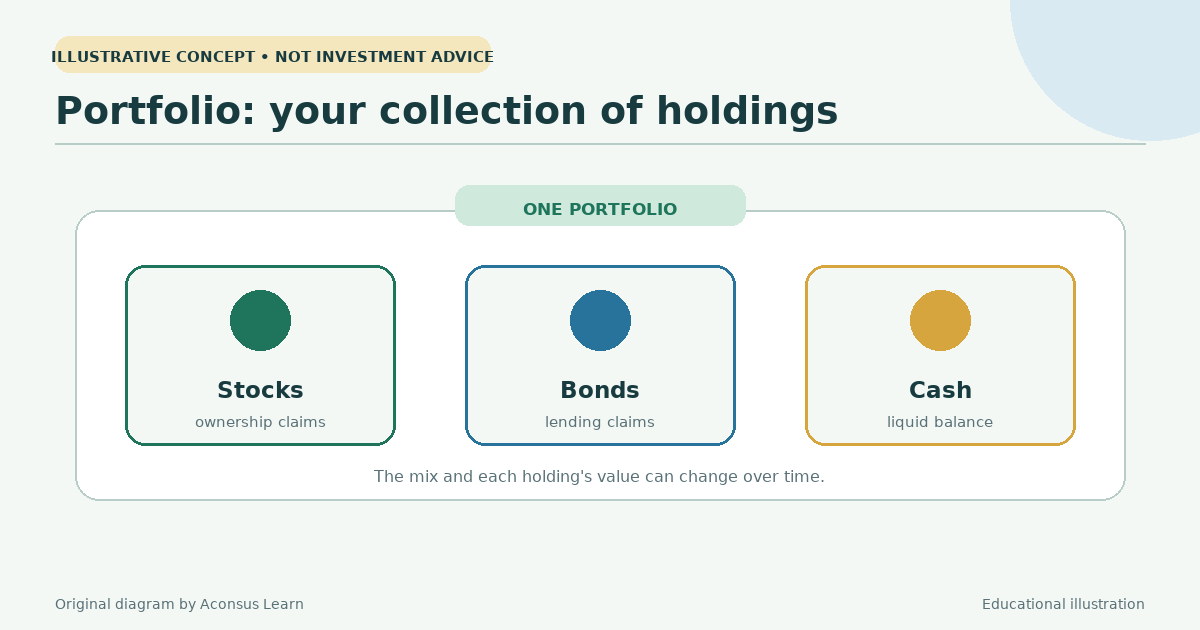
A portfolio is the complete collection of investments held by a person or institution.
Definition
A portfolio is the combined set of investments an investor owns. It may contain stocks, bonds, funds, cash, real estate, commodities, or other assets, whether they sit in one account or several.
Think across accounts
A brokerage screen is not necessarily a whole portfolio. An investor might hold an ETF in a taxable account, mutual funds in a workplace plan, and cash elsewhere. Viewed together, those holdings determine exposure to markets and the chance of reaching a goal. Investor.gov and Vanguard both describe a portfolio as a collection of holdings, not as a particular product.
A useful inventory records each holding's value, investment type, currency, account, fees, and tax treatment. The next step is to group economically similar holdings. Owning several funds does not guarantee diversification if all of them concentrate on the same large technology companies.
Build around a purpose
Portfolio design begins with the money's job. A near-term home deposit and retirement savings decades away usually call for different mixes because their time horizons and capacity for loss differ. Asset allocation turns those constraints into target percentages for broad asset classes.
Performance should be assessed against the goal and an appropriate benchmark, after fees and taxes where relevant. A portfolio that trails a stock index may still be doing its job if it deliberately holds bonds to limit losses. Conversely, a high return does not reveal how much risk was taken to obtain it.
Maintain the collection
Market moves, contributions, withdrawals, and life changes alter a portfolio. Periodic review can reveal an unintended concentration or a mix that no longer fits the goal. Rebalancing means restoring target weights, either by directing new money to underweight assets or by trading. Trading can create costs and taxable gains, so the method and frequency matter.
A portfolio is therefore both a snapshot and a plan. The list of holdings shows what is owned today; target weights and review rules explain how decisions will be made tomorrow. Neither a particular allocation nor frequent activity guarantees a profit or prevents loss.
Hypothetical example
Maya has $30,000 in a retirement fund, $8,000 in a broad stock ETF, $7,000 in bonds, and $5,000 in cash. Her portfolio is the full $50,000, not just the taxable ETF account. Stocks represent 76% only if the retirement fund is entirely stocks; she must inspect that fund before calculating her real allocation.
Limitations to keep in mind
- Several holdings can share the same underlying securities, creating hidden concentration.
- Ignoring fees, taxes, liquidity, or foreign-currency exposure can make a portfolio look safer or more profitable than it is.
- Past portfolio performance does not guarantee future results.
Sources and further reading
- Portfolio — Investor.gov, U.S. Securities and Exchange Commission
- Investment portfolios: Asset allocation models — Vanguard
Published ; Reviewed . Automated editorial source comparison; no external certification Claims compared with cited sources: 1
The SEC glossary includes commodities explicitly; Vanguard's examples emphasize stocks, bonds, cash, and real estate. These are examples, not conflicting limits.