
Portfolio building
Asset Allocation
Asset allocation is the decision about how much of a portfolio belongs in broad investment categories.
Definition
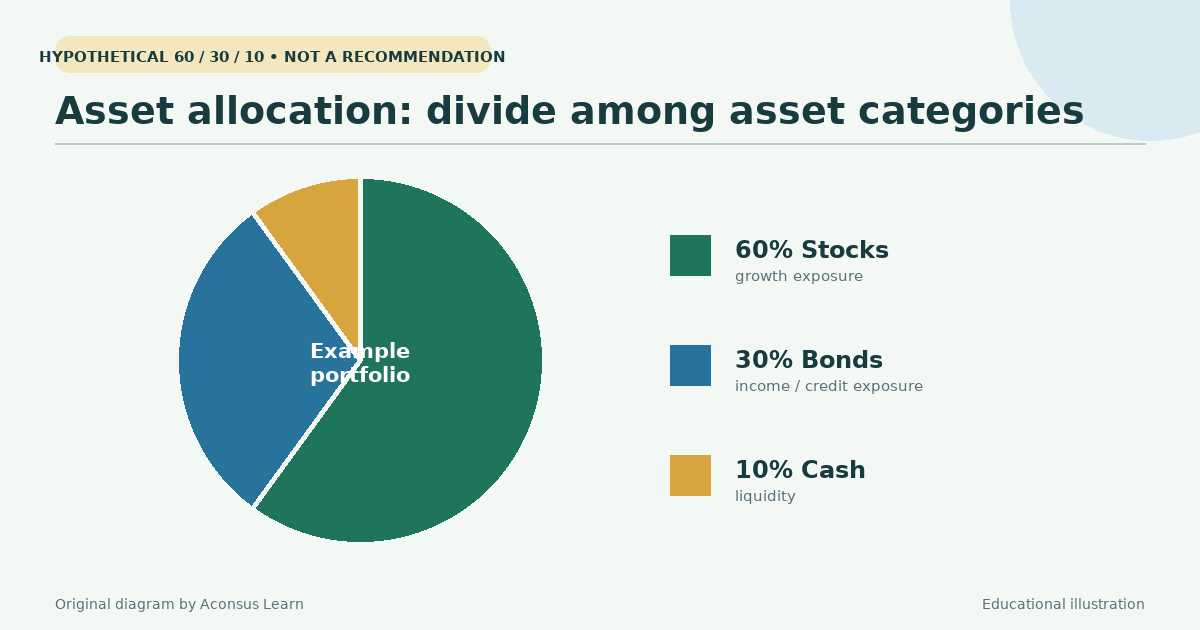
Asset allocation divides a portfolio among asset classes such as stocks, bonds, and cash. The appropriate mix depends on an investor's objectives, time horizon, need for liquidity, and ability and willingness to accept loss.
Turn goals into a mix
Investor.gov defines asset allocation as dividing investments among assets such as stocks, bonds, and cash. FINRA describes the same process as deciding what percentage of a portfolio to invest in different asset classes. This is different from selecting a particular stock or fund: allocation sets the broad risk structure first.
No universal percentage is best. Money needed next year cannot recover from a long decline as readily as retirement money with decades remaining. Stable income, emergency savings, debts, and emotional tolerance for falling markets can also affect a suitable mix. A questionnaire can inform the decision but cannot remove uncertainty.
Implement and diversify
After choosing targets, investors select holdings to represent each class. A target might split among global stocks, high-quality bonds, and cash reserves. Diversification then operates within those buckets so that one company or issuer does not dominate.
Labels require care. A balanced fund can hold a changing mix; a high-yield bond fund can behave differently from government bonds; cash-like products can carry credit or liquidity constraints. Look through funds to understand the actual exposure, expenses, and currency.
Rebalance deliberately
Returns cause weights to drift. If stocks rise faster than bonds, a 60% stock target can become 70%, exposing the portfolio to more equity risk than intended. Rebalancing restores targets by trading or directing contributions and withdrawals toward underweight classes.
A calendar review or tolerance bands can limit impulsive activity. Rebalancing can force disciplined selling of relative winners and buying of relative laggards, but it neither forecasts markets nor guarantees better returns. Sales may create taxes and costs, and tax rules vary by country and account type.
Hypothetical example
Jordan assigns a $100,000 long-term portfolio to 60% diversified stocks, 30% bonds, and 10% cash. After a stock rally the values become $72,000, $29,000, and $9,000. Stocks are now about 65.5% of $110,000. Jordan can compare this drift with a pre-set band before rebalancing rather than reacting to headlines.
Limitations to keep in mind
- An allocation based on an incorrect time horizon or loss capacity can force selling at a bad time.
- Asset-class labels can hide leverage, credit, currency, or liquidity risks.
- Rebalancing may trigger transaction costs or taxes and does not guarantee profit.
Sources and further reading
- Asset Allocation and Diversification — Investor.gov, U.S. Securities and Exchange Commission
- Asset Allocation and Diversification — FINRA
Published ; Reviewed . Automated editorial source comparison; no external certification Claims compared with cited sources: 1
FINRA provides illustrative class-return history and Investor.gov provides life-stage examples; neither presents a universally correct allocation.