
Portfolio building
Diversification
Diversification spreads exposure across investments so one disappointment has less power over the whole portfolio.
Definition
Diversification is the practice of spreading money among and within asset classes, issuers, industries, regions, or other sources of return to reduce concentration risk. It can reduce risk, but it cannot eliminate market losses.
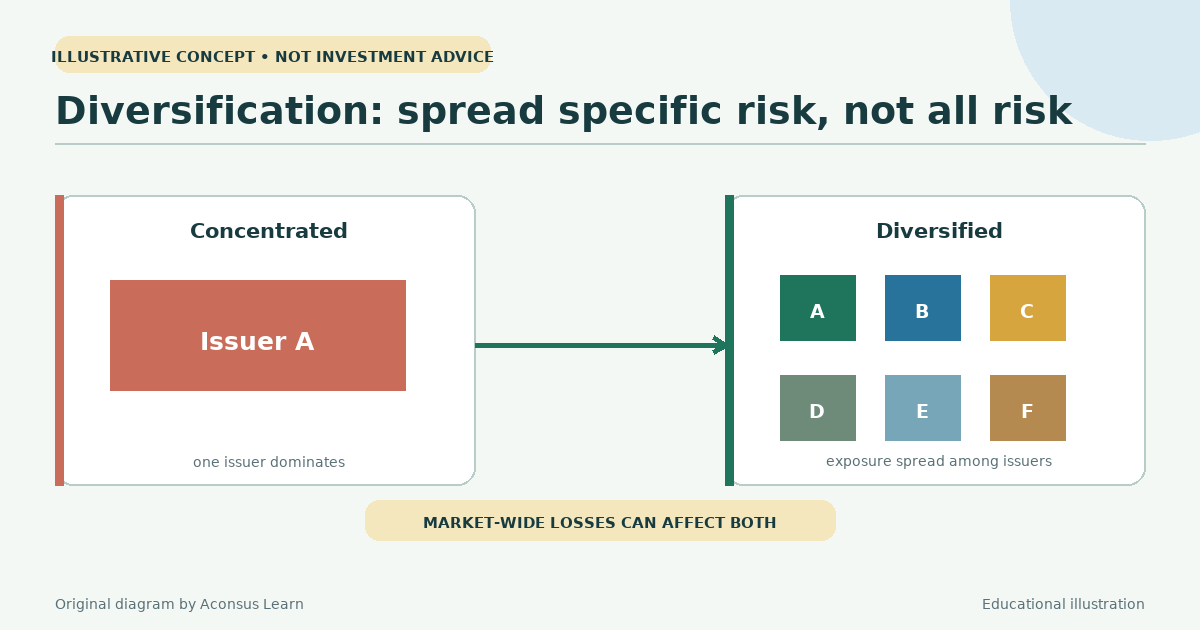
Different exposures, not merely more names
FINRA describes diversification as spreading investments both among and within asset classes. Investor.gov likewise frames it as spreading money among investments to reduce risk. The mechanism matters: when holdings respond differently to the same event, weakness in one may be partly offset by resilience in another.
Counting tickers is a poor shortcut. Ten funds that track similar indexes may own many of the same companies. Meaningful diversification asks what drives each holding: company profits, interest rates, credit conditions, geography, currency, or commodity prices. Correlation can also change, especially in stressed markets.
Diversify in layers
The first layer is usually broad asset allocation across categories such as stocks, bonds, and cash. Within stocks, an investor might spread exposure across companies, sectors, sizes, and countries. Within bonds, issuers, maturities, and credit quality matter. Broad funds can make this easier, although their index rules and holdings still deserve inspection.
Diversification is not a race to own every available asset. Each holding should have a role, understandable costs, and suitable liquidity. Adding complex or expensive products solely because they look different can introduce risks that outweigh any diversification benefit.
Know what it cannot do
Diversification primarily addresses the damage from concentration. It does not guarantee a profit, set a floor under account value, or remove broad market risk. Stocks across many sectors can fall together; bond prices can decline when rates rise; international holdings may add currency and political risks.
Review the entire portfolio, including workplace plans and concentrated employer stock. Rebalancing can restore intended exposure after market moves. Tax, transaction-cost, and jurisdictional consequences should be considered before selling.
Hypothetical example
An investor owns $20,000 split equally among four airline stocks. Four names do not provide much industry diversification because fuel costs and travel demand affect all four. Moving part to a broad stock fund and high-quality bonds spreads the economic drivers, although the revised portfolio can still lose value.
Limitations to keep in mind
- Diversified assets may become more correlated during a market shock.
- Over-diversifying into unfamiliar, costly products can obscure rather than reduce risk.
- A diversified portfolio can still lose money and diversification does not assure a profit.
Sources and further reading
- Asset Allocation and Diversification — FINRA
- Asset Allocation and Diversification — Investor.gov, U.S. Securities and Exchange Commission
Published ; Reviewed . Automated editorial source comparison; no external certification Claims compared with cited sources: 1
Investor.gov uses the broad phrase 'reduce risk'; FINRA specifies the risk of major losses from over-emphasizing one security or class. The article states the narrower limitation explicitly.