
Returns and valuation
Dividend
A dividend is a distribution a company makes to shareholders, commonly in cash or additional shares.
Definition
A dividend is part of a company's assets or earnings distributed to eligible shareholders, usually as cash or stock. Dividends are declared by the board, are not guaranteed, and form one component of total shareholder return.
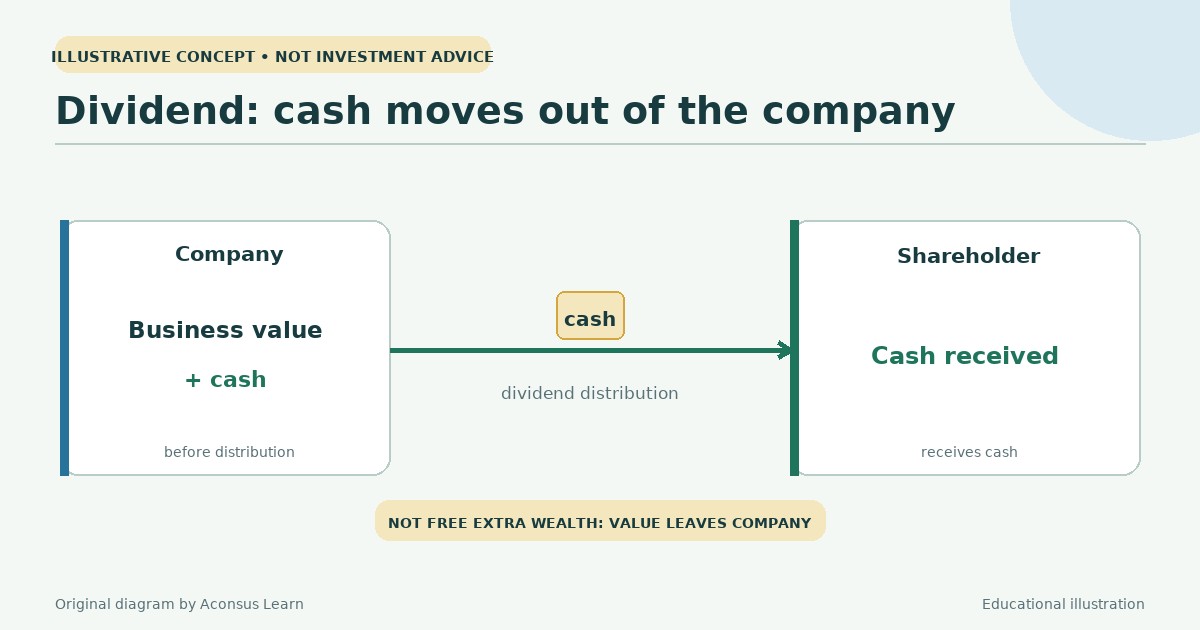
A distribution, not free money
Investor.gov defines a dividend as a portion of company profit paid to shareholders. Nasdaq's educational overview describes dividends as cash distributions and also discusses stock dividends. Companies may pay regularly, occasionally, or not at all. A board can reduce, omit, or suspend a payment.
A dividend transfers value from the company to shareholders. On the ex-dividend date, the market price can adjust downward by roughly the distribution amount, though ordinary trading forces also move it. Receiving $1 does not by itself create $1 of new wealth.
Read dates and yields carefully
The declaration, ex-dividend, record, and payment dates serve different purposes. An investor generally must own before the ex-dividend date to receive the declared distribution under the market's settlement rules. Exact mechanics can vary by security and market.
Dividend yield commonly divides annualized dividends per share by share price. It moves when either input changes. An unusually high yield may reflect a falling price or a payment the market expects to be cut, so yield alone is not a measure of quality.
Connect income to total return
Total return combines distributions and price change. Reinvesting dividends buys more shares and can support compounding, but those shares remain exposed to market loss. Companies that retain earnings may instead reinvest in operations or repurchase shares; dividend policy or a P/E ratio alone does not determine value.
Tax treatment differs by country, investor, account, and dividend type. Withholding taxes may apply to foreign holdings. Investors should use the rules for their jurisdiction rather than assuming a quoted yield equals spendable after-tax income.
Hypothetical example
A company declares a $0.50 quarterly cash dividend. At a $40 share price, annualizing four equal payments suggests a 5% indicated yield: $2 divided by $40. The company has not promised four future payments, and the share price can change, so 5% is neither guaranteed income nor total return.
Limitations to keep in mind
- Boards can reduce or cancel dividends.
- A high quoted yield can result from a collapsing share price and may signal distress.
- Taxes and withholding vary by jurisdiction, account, and investor.
Sources and further reading
- Dividend — Investor.gov, U.S. Securities and Exchange Commission
- Dividends: All the Basics You Need to Know — Nasdaq
Published ; Reviewed . Automated editorial source comparison; no external certification Claims compared with cited sources: 1
Investor.gov's short glossary ties dividends to profit; Nasdaq discusses distributions more broadly. Corporate-law and accounting details vary, so the article uses 'assets or earnings' rather than claiming every distribution is current-period profit.