
Returns and valuation
Capital Gain
A capital gain is the increase recognized when an asset is sold for more than its relevant cost basis.
Definition
A capital gain generally arises when proceeds from disposing of a capital asset exceed its adjusted basis. A rise while the asset is still held is commonly called an unrealized gain; tax recognition and calculation depend on jurisdiction.
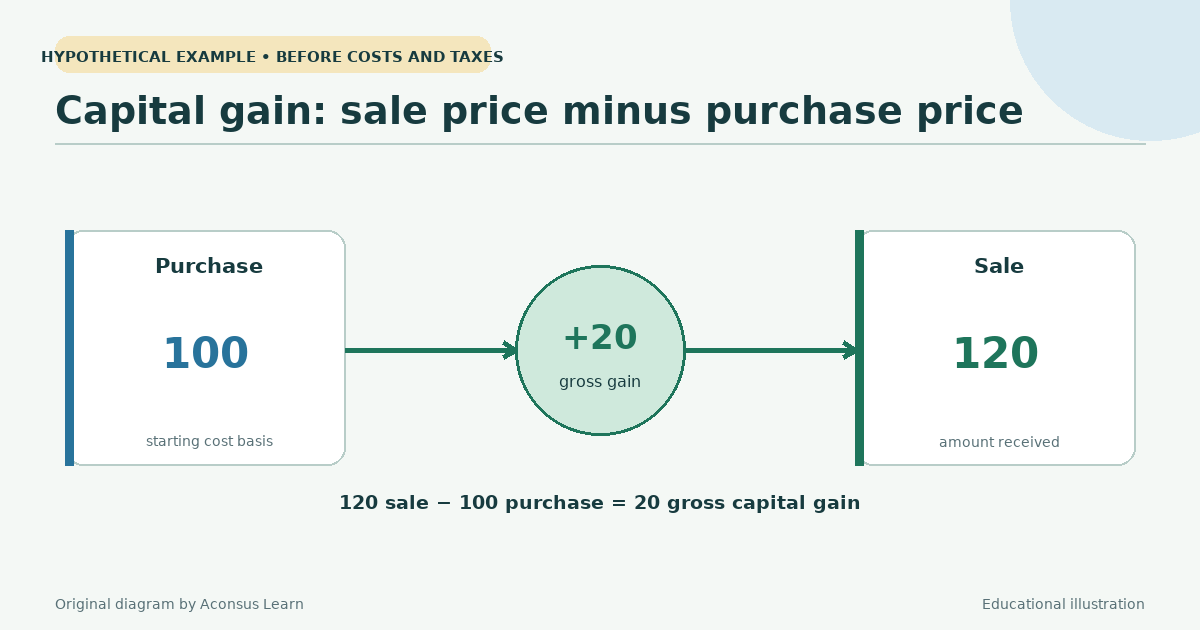
Price change versus realized gain
Investor.gov defines a capital gain as profit when an investment is sold above the price paid. The U.S. Internal Revenue Service uses a more tax-specific comparison: amount realized minus adjusted basis. Basis often starts with cost but can change because of fees, corporate actions, depreciation, gifts, or inheritance.
If market value rises before sale, the gain is unrealized. Selling or another disposal generally realizes it, though the legal trigger differs by tax system. A gain is not the same as sale proceeds: selling for $12,000 after investing an adjusted $10,000 produces a $2,000 gain, not $12,000.
One part of return
Capital appreciation combines with income such as interest or a dividend to produce total return. Fees and taxes can reduce what the investor keeps. Inflation can also make a positive nominal gain a negative gain in purchasing-power terms.
Losses matter too. Tax systems may permit capital losses to offset gains, subject to limits and classifications. Rules for holding periods, loss harvesting, wash sales, and carryforwards are jurisdiction-specific and change over time.
Keep basis records
Reinvested distributions can create additional purchase lots, each with its own basis and date. Stock splits and mergers can alter per-share basis without changing total economic value at the event. Broker reports help, but investors remain responsible for applicable records.
Do not let tax considerations alone determine an investment decision. Risk, fees, liquidity, diversification, and whether the asset still fits the portfolio also matter. Consult current local rules or a qualified adviser for personal tax treatment.
Hypothetical example
Lee buys 100 shares for $20 each and pays a $10 purchase fee, making an illustrative basis of $2,010. Lee later sells them for $25 each and pays a $10 selling fee, receiving $2,490. The illustrative gain is $480. Actual basis and tax treatment depend on local law and the account.
Limitations to keep in mind
- Tax basis can differ from the simple purchase price after fees, distributions, gifts, or corporate actions.
- Tax rates and realization rules vary by jurisdiction and holding period.
- A paper gain can disappear before sale, while selling can create tax and reinvestment consequences.
Sources and further reading
- Capital Gain — Investor.gov, U.S. Securities and Exchange Commission
- Topic no. 409, Capital gains and losses — Internal Revenue Service
Published ; Reviewed . Automated editorial source comparison; no external certification Claims compared with cited sources: 1
Investor.gov says price paid; IRS says adjusted basis and amount realized. The article uses the more precise tax formulation and identifies its jurisdictional nature.