
Returns and valuation
Compound Interest
Compound interest is interest earned on principal plus previously credited interest.
Definition
Compound interest occurs when interest is added to principal and later interest is calculated on that larger balance. In investing, compounding more broadly describes returns generating additional returns when gains and income remain invested.
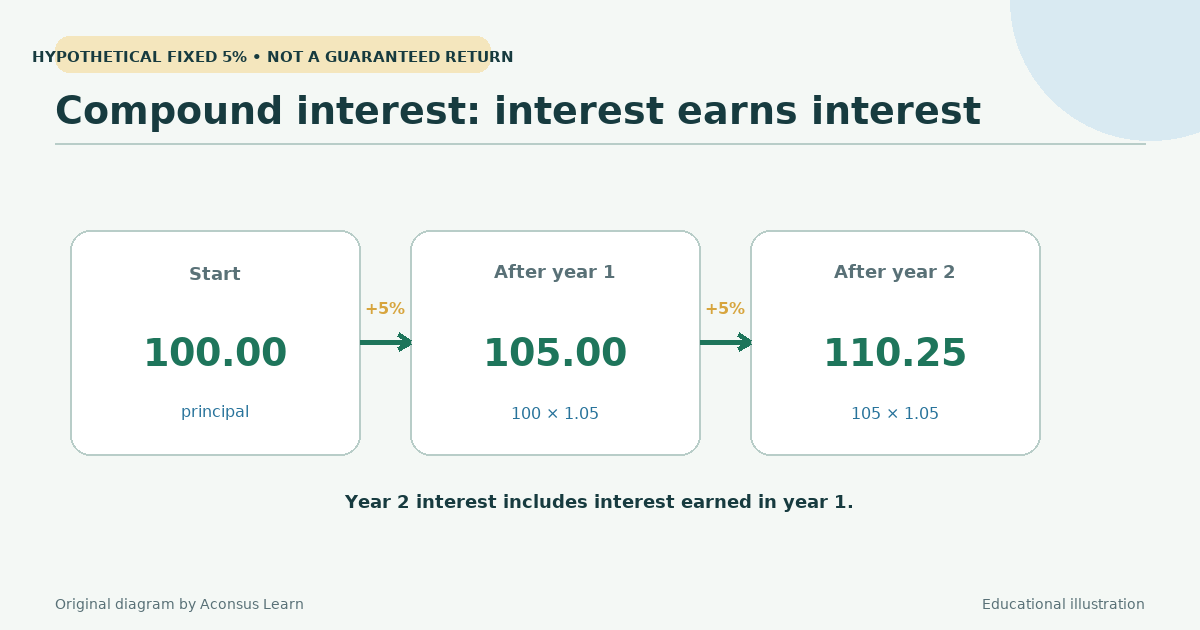
Interest on interest
Investor.gov calls compound interest the interest earned on interest. The FDIC explains that credited interest joins principal, creating a new principal on which the next interest amount is earned. This produces nonlinear growth when the rate is positive and money remains untouched.
For a fixed rate compounded periodically, future value is principal multiplied by (1 + rate per period) raised to the number of periods. More frequent compounding produces a somewhat higher effective yield when the stated rate and other terms are equal.
Compounding beyond deposits
Investment returns are uncertain, unlike a simplified fixed-rate example. Reinvested dividends can buy additional shares that may themselves receive distributions, but prices and payments can fall. Capital gains can compound while value stays invested, yet fees, taxes, withdrawals, and losses interrupt the path.
Time is powerful because each period builds on the preceding balance. It also magnifies differences in costs. A recurring fee reduces the base left to earn future returns, so its long-run effect can exceed one year's charge.
Compare rates on the same basis
A nominal annual rate, annual percentage yield, and investment return are not interchangeable. APY incorporates compounding for deposits under applicable disclosure conventions. Loans also compound in some circumstances, causing debt to grow; compounding is a mathematical process, not automatically a benefit.
Taxes vary by jurisdiction and account. Some systems tax income when paid, others offer tax-advantaged accounts, and realized capital gains can have separate rules. Projections should state assumptions rather than presenting smooth growth as a promise.
Hypothetical example
$1,000 earning a fixed 5% annually becomes $1,050 after one year. If the $50 stays in the account, the second year's 5% is $52.50, producing $1,102.50. Simple interest on the original principal would produce only $1,100. Real investments do not deliver a fixed 5% merely because the formula uses it.
Limitations to keep in mind
- Examples using constant positive rates can create unrealistic expectations for market investments.
- Fees, taxes, withdrawals, and negative returns reduce or reverse compounding.
- Compound interest can increase debt as well as savings.
Sources and further reading
- What is compound interest? — Investor.gov, U.S. Securities and Exchange Commission
- Chapter 5: Compound Interest — Federal Deposit Insurance Corporation
Published ; Reviewed . Automated editorial source comparison; no external certification Claims compared with cited sources: 1
Investor.gov's classroom example uses annual compounding, while the FDIC lesson describes repeated crediting more generally. The article does not imply one universal frequency.