
Returns and valuation
Market Capitalization
Market capitalization is the market value of a company's outstanding equity shares.
Definition
Market capitalization, or market cap, equals a company's current share price multiplied by its number of outstanding shares. It is a market-based measure of equity size, not the price to purchase the entire operating business.
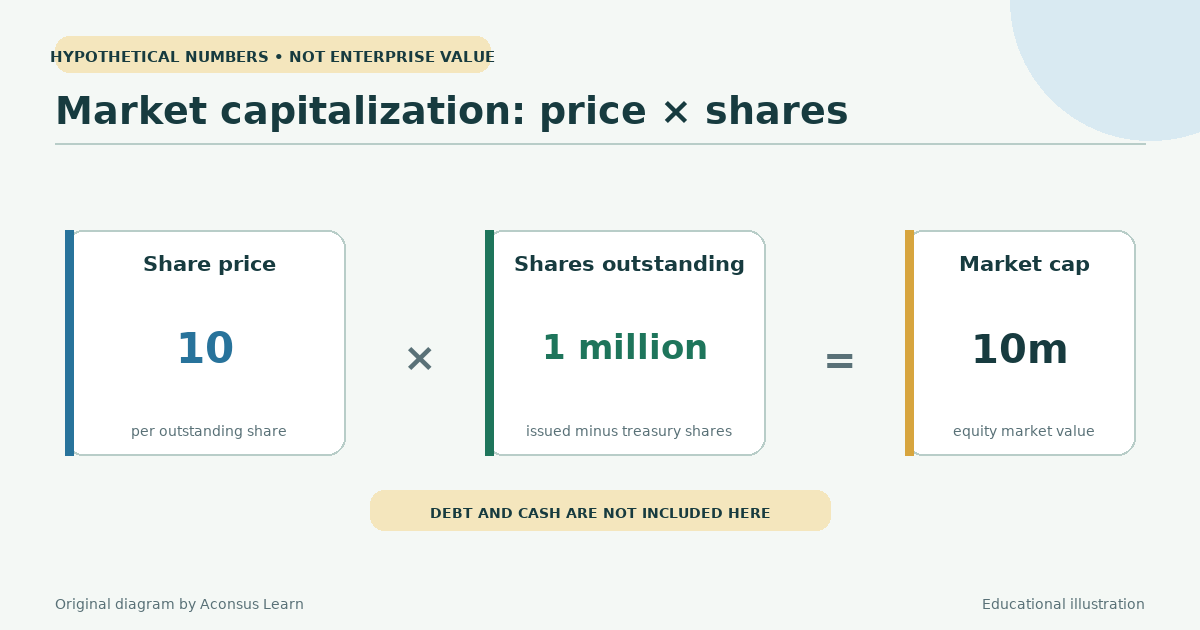
Price times shares
FINRA gives the market-cap formula as outstanding shares multiplied by current stock price. Nasdaq likewise defines it as the total dollar value of outstanding shares. A $100 share is not necessarily a larger company than a $10 share because the number of shares differs.
Share counts can change through issuance, repurchases, employee compensation, conversions, mergers, and splits. A conventional stock split lowers price and raises share count proportionally, so it does not by itself change market cap.
A size label, not a quality grade
Investors and index providers group companies as large-, mid-, small-, or micro-cap. Cutoffs vary by provider and can change with markets. These labels help describe a portfolio and build indexes, but they do not say whether a stock is cheap, profitable, or safe.
Smaller companies may have less trading liquidity and less diversified businesses, while large companies can still be volatile or fail. Size can influence risk characteristics, but market cap alone is not due diligence.
Do not confuse equity value with enterprise value
Market cap values common equity at quoted market prices. It does not directly add debt or subtract cash. Enterprise-value calculations attempt a broader view of operating-business value and require additional balance-sheet adjustments.
Multiplying every share by the last traded price is also theoretical: trying to buy all shares could move the price, and a takeover may involve a premium. Market cap is still useful for scale and weighting. In a capitalization-weighted market index, companies with larger market caps receive larger weights.
Hypothetical example
Company A has 5 million shares at $20, so its market cap is $100 million. Company B has 50 million shares at $5, so its market cap is $250 million. B is larger by this measure despite its lower share price. Debt and cash could reverse their ranking under a different valuation measure.
Limitations to keep in mind
- Category thresholds such as large-cap and small-cap are not universal.
- Market cap can move sharply with price and does not measure balance-sheet strength.
- It is not enterprise value or the guaranteed price at which an entire company could be acquired.
Sources and further reading
- Market Cap Explained — FINRA
- Market capitalization Definition — Nasdaq
Published ; Reviewed . Automated editorial source comparison; no external certification Claims compared with cited sources: 1
FINRA discusses whether restricted shares are included and notes varying size cutoffs; Nasdaq's glossary is briefer. The article avoids imposing one category scheme.